The Difference Between Faith and Trust and Why it Matters
In 1859, French tightrope walker Charles Blondin captivated thousands by walking across Niagara Falls on a rope suspended 160 feet above the roaring waters. Stretching 1,100 feet (more than three football fields) the crossing was one of the most daring feats of its time. Over the years, he repeated the performance hundreds of times, each crossing more daring than the last—walking backward, blindfolded, even stopping midway to cook an omelet. One of his most famous acts was pushing a wheelbarrow across the rope.
Before one crossing, Blondin asked the crowd, "Do you believe I can do this?" Everyone enthusiastically replied, "Yes!" He then asked, "How many of you trust me?" Again, every hand went up. Smiling, he responded, "Then who wants to get into the wheelbarrow?"
The crowd's silence revealed a profound truth: it's one thing to believe, but it's another to entrust your life to someone else.
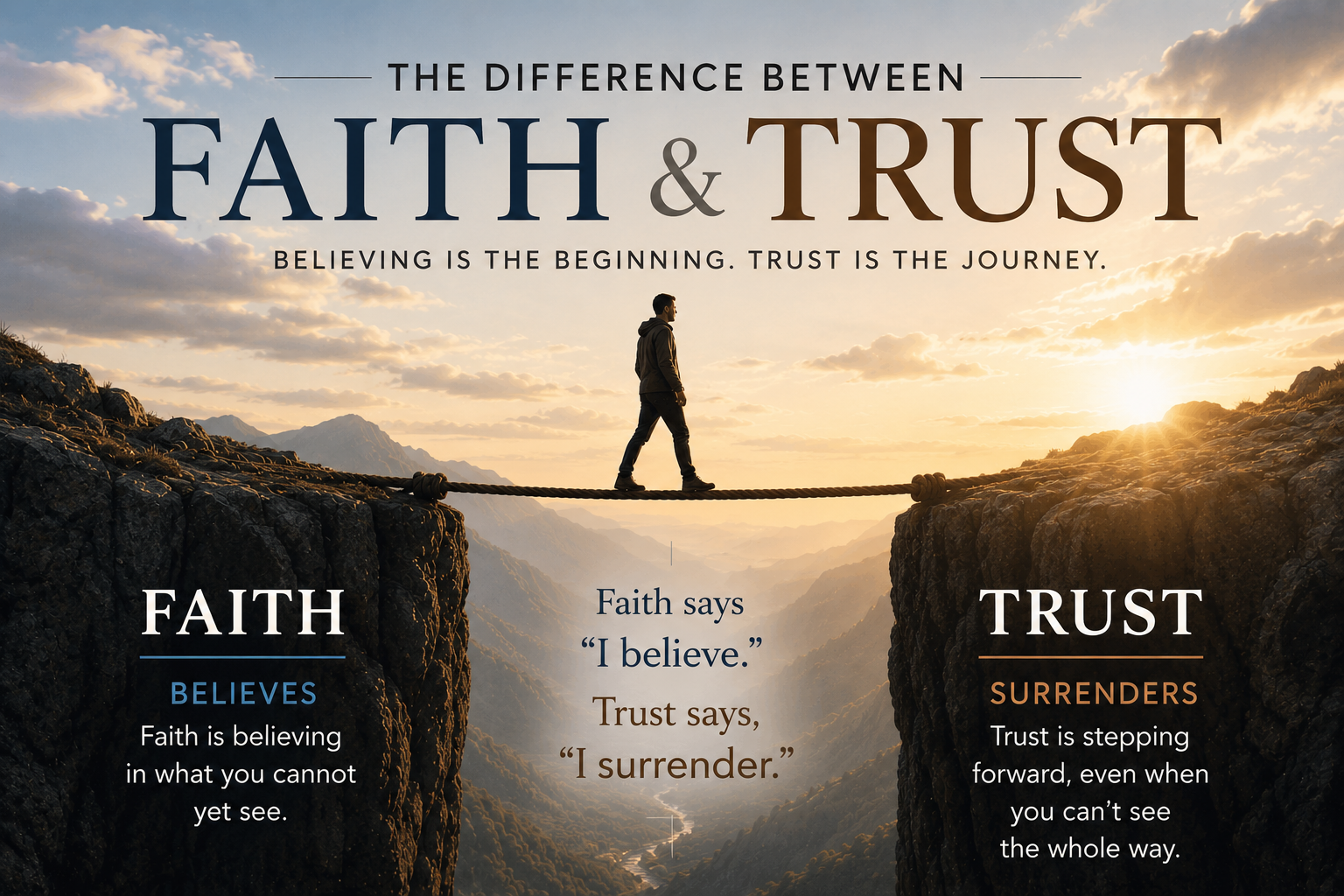
Faith and trust are not the same thing, though many of us interchange the two. Trust is confidence in the person guiding you; faith is belief in the possibility of what lies ahead.
The distinction is important. Whether with God, a spouse, a friend, or a physician, belief alone is not enough. Relationships deepen only when we become vulnerable enough to rely on another person.
In previous LFA Purpose podcasts both Kevin O'Neill (March 19, 2026 and April 9, 2026) and Dr. Spencer Baron (June 29, 2026) highlight the importance of trust in the relationships they build with athletes and patients. Kevin earned the trust of professional athletes by showing up every day, understanding their needs, and proving that he always had their best interests at heart. Dr. Baron builds trust by listening deeply, treating the whole person, and guiding patients with compassion and expertise.
Yet, both would likely agree that healing and growth require something more than trust alone, they require faith. An injured athlete must have faith that recovery is possible before stepping back onto the field. A patient must have faith that healing can occur, even when answers are uncertain or progress is slow.
The same is true in life. We trust people because of what they have shown us, but we live by faith when we choose to move forward without knowing exactly where the journey will lead. Whether in medicine, coaching, relationships, or our search for purpose, trust provides the foundation, but faith gives us the courage to take the next step.
Faith has been recognized as one of the three cardinal virtues, along with charity and hope. In scriptural terms, we read in Hebrews 11:1 faith is described as the “substance of things hoped for, the evidence of things not seen.” So, faith is beyond the requirement of proof, it exists without verification. Faith is believing in someone or something; it is the conviction that what you believe is true. If substantiation was required for you to believe, it would not be identified as faith. Faith’s most unique characteristic is in the world of mystery. Mystery by its very nature entails the unknown, the untried and the uncertain.
Certainty is the direct opposite of faith. People who struggle with their religious beliefs or seek to confirm them, risk diminishing the very faith they are challenged to possess. In the movie Conclave, Cardinal Lawrence, played by Ralph Fiennes, says: "Over the course of many years in service of our Mother the Church, let me tell you, there is one sin which I have come to fear above all others: certainty. Certainty is the great enemy of unity. Certainty is the deadly enemy of tolerance. Even Christ was not certain at the end. 'My God, my God, why have you forsaken me?' he cried out in his agony at the ninth hour on the cross. Our faith is a living thing precisely because it walks hand in hand with doubt. If there was only certainty and no doubt, there would be no mystery, and therefore no need for faith. Let us pray that God will grant us a Pope who doubts. And let Him grant us a Pope who sins and asks for forgiveness and who carries on."
Faith Begins with Belief. Trust Begins with Surrender
In his book Dynamics of Faith the brilliant Protestant theologian, Paul Tillich suggests that if one never doubts his or her faith, then they have never had any faith at all. Essentially, faith is accompanied by risk, requiring a courage that confronts insecurity. Therefore, faith to be true to its character is dynamic, it is not a mere assent to believe but an active process that examines your personality and the need to believe.
A “loss of faith” is not a death sentence for faith but rather a confirmation of your search for faith. According to Tillich, “existential doubt and faith are poles of the same reality.” Consequently, we live our lives seeking to have faith, and once we discover it, we test it, question it, we may even abandon our old ways of believing and find new ones because we constantly need to engage our intellects.
As Saint Paul has said in 1Corinthians 13:11-13, “When I was a child, I spoke like a child, I thought like a child, I reasoned like a child. When I became a man, I gave up childish ways.” Obviously, as we grow older our faith evolves, who and what we believed in changes and furthermore, the way we placed our faith changes primarily because our perspective has changed. How we originally saw things no longer exists.
Trust is Faith Put Into Action
While faith is believing in someone or something, trust is the decision to act on that belief. Faith may be described as a noun; trust is a verb because it requires our active participation. Faith comes first, but trust is its natural expression.
Faith can exist without proof, but trust is developed through experience, reliability, loyalty, and consistency. It is the deliberate choice to place ourselves in another's hands because we believe they are worthy of our confidence. Yet trust always involves risk. When it is broken through betrayal or disappointment, the resulting wounds can be deep, often taking years to heal.
There can be no true faith or trust without one’s willingness to take a risk. Playing it safe in life will never last for any length of time simply because we are expected to believe or trust in something or someone every day of our lives.
Consider our dependency on public transportation, we presume the train or the bus we be on time, we have faith in the system. Our trust is exemplified in the timeliness of the engineer, conductor or driver who have consistently shown their reliability. A person can have faith that the mode of transportation will be there, but that individual displays trust by waiting for it.
Faith is the confidence and belief something is worthy of our intellectual, spiritual and emotional investment even when it is uncertain. Trust involves taking a chance, placing yourself in jeopardy and being vulnerabile. The loss of faith or trust is deeply distressing and hurtful. Still, there is a monumental distinction between intellectual confidence and active trust.
There are countless numbers of religious people who believe in God, but not so many who trust Him. By nature, we are cautious about exposing ourselves to hurt and disappointment. Opening ourselves to pain is a risk few are willing to take without some evidence that our faith and trust are well placed. Because betrayal is always a possibility, we hesitate. We want reassurance before we are willing to believe and even more before we are willing to trust.
Yet it is only through that willingness to trust that we experience growth, healing, and transformation. Every meaningful relationship, every purposeful calling, and every step of faith requires us to surrender our need for certainty and move forward with courage. Perhaps the question is not whether we believe, but whether we are willing to trust enough to take the next step.
Today, ask yourself: Where in your life is fear keeping you from trust? What relationship, calling, or opportunity is inviting you to let go of certainty and step forward in faith? The life and work you are meant for may begin with one simple act of trust.
Five Steps to Deepen Faith and Trust
Step 1: Begin with prayer:
Heavenly Father,
You call me to believe even when I cannot see and
To trust even when I do not know what lies ahead.
Strengthen my faith so that I may confidently place my hope in You,
and deepen my trust so that I may surrender my fears into Your loving hands.
When uncertainty fills my heart, remind me that You are always faithful.
When I am tempted to rely only on proof or certainty, help me remember
that Your greatest works often begin with a simple act of faith.
Teach me to trust not only in Your promises but also in Your timing.
Give me the courage to be vulnerable, the wisdom to discern whom to trust,
and the grace to forgive when trust has been broken.
Step 2: Know What You Believe
Faith begins by discovering what you believe and why. Spend time in prayer, Scripture, and reflection to strengthen the foundation of your faith.
Step 3: Remember God's Faithfulness
Recall the moments when God has guided, protected, or provided for you. Reflecting on His faithfulness in the past gives you confidence to trust Him with the future.
Step 4: Choose Trust One Step at a Time
Trust isn't a feeling, it's a decision. Even when you cannot see the outcome, choose to take the next faithful step.
Step 5: Surrender Your Need for Control
Fear often comes from wanting guarantees. Faith says, "I believe." Trust says, "I surrender."